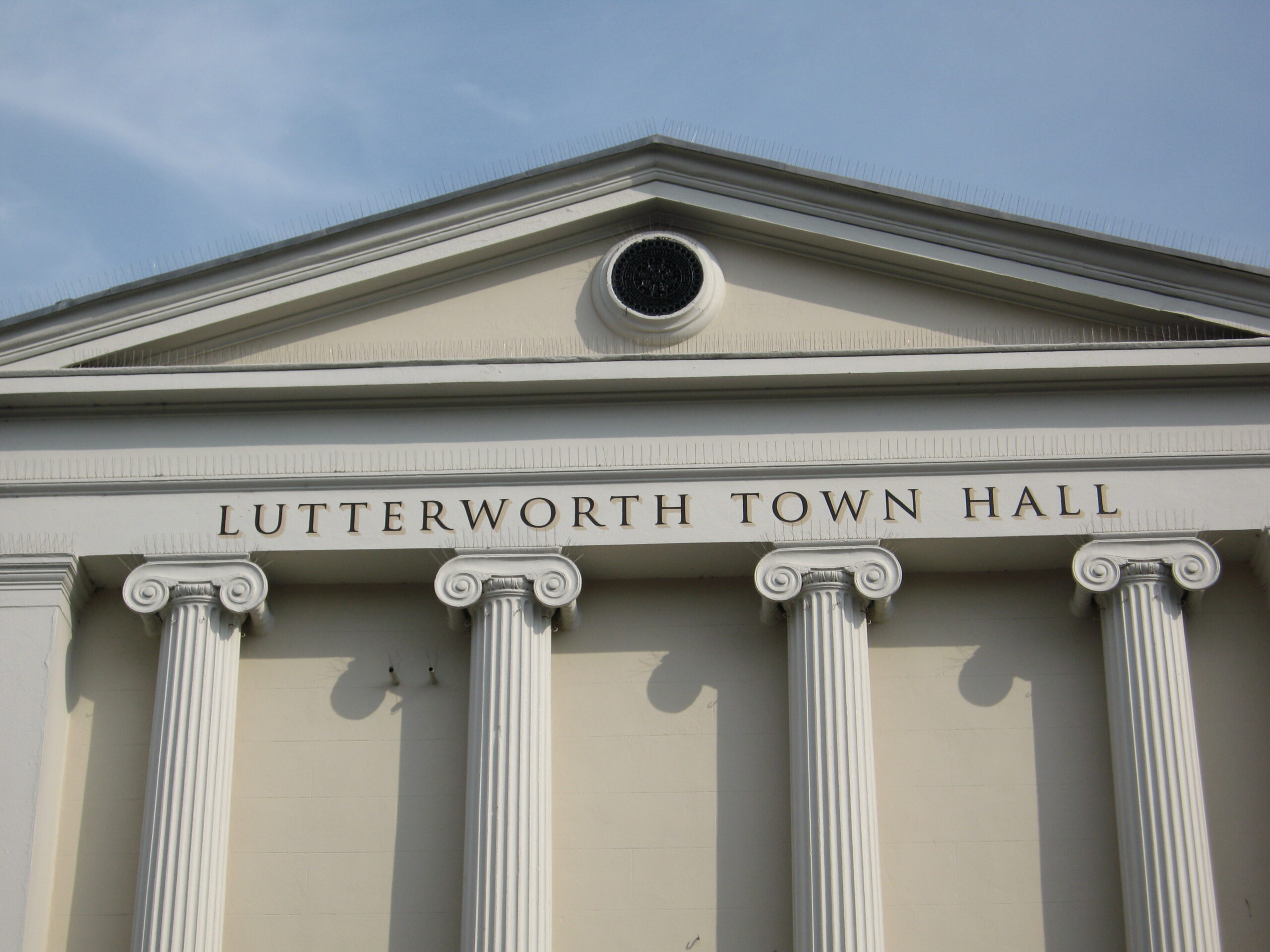
The building cost £1,600 and was loan financed through the town estates.
He was better known for the Hansom cab which he invented in 1835 and for the huge and pretentious Birmingham Town Hall, for which he was the architect. He later became a very successful designer of Roman Catholic churches.
It was originally intended that a statue of John Wycliffe should stand in the middle of the columns facing the High Street but the money ran out. Funding difficulties have been a problem for the town hall right through its life!!
Its most regular use over its first 70 years was for the weekly or fortnightly sittings of the magistrates court, which had previously had to use inns or private houses. This use provided a regular and reliable income.
The ground floor was originally half open to the street market that it served. In the early 1900s the openings were filled in and you can tell where this has been done because they appear to be blind windows.
In the latter part of the 19th century the upper floor was lit by a Bavarian crystal chandelier. It was bought on behalf of the Town Estates for the Town Hall on the centre of the ceiling and was lit by candles. There were 26 individual lights each in 3 sections. The holders were made from sterling silver and the whole assembly was hung from a huge crystal fitting. When gas came to Lutterworth it was decided to replace the chandelier by gas lamps so the chandelier was dismantled and sold piecemeal.
In the early 20th century a new courthouse was proposed and this led to representations to the County Council that the new courthouse should offer public meeting and social facilities. Had this proposal been accepted the Town Hall would probably have been demolished. However, the proposal failed but when the new courthouse was opened in 1906 the Town Hall lost its main regular source of income.
Funding and general maintenance was a continual problem and in 1983 after various crises the Charity Commission approved that the Town Hall should be administered and managed as a separate charity with its own Trustees and committee but still financially tied to the Town Estates. This situation continues today
The Town Hall receives most of its funds from hiring out its facilities plus a contribution from the Town Estates under the Charity Commission arrangements. Together this covers the annual running costs. However as a Grade II listed building it requires considerable upkeep and the funding for major repairs and re-decoration has to be found from grants and other sources, which is always a problem.
A Civil Wedding Ceremony licence has now been granted to Lutterworth Town Hall, enabling civil wedding ceremonies to be conducted from January 2012.